
Did you know that contact lens wear is one of the most common triggers of dry eye symptom, and that millions of people quietly put up with discomfort that is entirely avoidable?
At Safarian & Simon we are experts on the topic of what to know about dry eyes, and our dry eye clinic has helped countless people with their dry eye problems. That is why we want to inform you about what you can do to manage the problem, and when it might be time to reassess your approach to vision correction.
Why do contact lenses cause dry eyes?
To understand the connection, it helps to know how contact lenses interact with your tear film.
Your tear film is a thin, complex layer of fluid that coats the surface of the eye. It has three distinct layers: an oily outer layer that slows evaporation, a watery middle layer that provides moisture and oxygen, and an inner mucin layer that helps the tear film stick to the eye’s surface. This system works beautifully when left undisturbed.
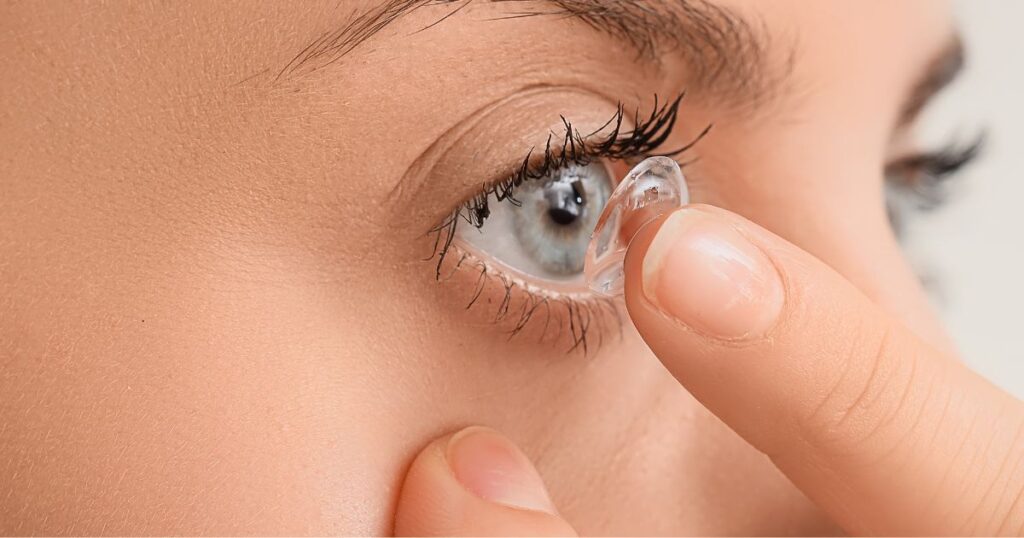
Contact lenses sit directly on the tear film, dividing it into two thinner layers: one in front of the lens and one behind it. Both layers are less stable than the intact tear film, meaning they evaporate faster and break down more quickly. The longer you wear lenses, the more this disruption accumulates throughout the day.
On top of this, contact lenses absorb moisture from the eye to stay hydrated, meaning they are essentially competing with your ocular surface for the tears you produce. For someone whose tear production is already marginal, this can tip the balance into uncomfortable dryness.
Symptoms to watch for
Contact lens-related dry eye can present in several ways. Some are immediately obvious; others are easy to dismiss as tiredness or screen fatigue.
Discomfort that worsens through the day
Many contact lens wearers feel fine in the morning but notice increasing irritation as the day progresses. This is a classic sign of tear film depletion: your eyes start the day with adequate lubrication but struggle to keep up with demand over time.
End-of-day lens removal becoming a relief
If taking your lenses out at the end of the day feels like genuine relief rather than routine, your tear film is likely struggling. Healthy lens wear should not feel uncomfortable.
A gritty or foreign body sensation
The feeling that something is caught in your eye, despite nothing being there, is a hallmark symptom of dry eye and is significantly amplified by contact lens wear.
Redness and irritation
Chronic dryness causes low-level inflammation on the ocular surface. This often appears as persistent redness, particularly around the edges of the lens.
Blurry or fluctuating vision
An unstable tear film causes the surface of the eye to become irregular. Vision may appear clear immediately after blinking but blur within seconds, a tell-tale sign that the tear film is breaking down too quickly.
Lens intolerance
In more advanced cases, wearers find they simply cannot tolerate lenses for more than a few hours at a time, or not at all. This is the point at which many people assume they have to give up lenses entirely but that is often not the case.
Can you still wear contact lenses if you have dry eyes?
For the vast majority of people, yes. Dry eye does not automatically mean the end of contact lens wear. It does, however, mean that the right lens choice, wearing schedule, and ongoing eye care become critically important.
Several factors will determine what is possible for you:
| Factor | Why it matters |
| Severity of dry eye | Mild to moderate dry eye is often manageable with the right lenses and drops |
| Lens material | Some materials retain moisture far better than others |
| Wearing schedule | Daily disposables reduce protein and lipid build-up on the lens surface |
| Lens fit | A poorly fitting lens disrupts the tear film and amplifies dryness |
| Environment | Air conditioning, screen use and low humidity all worsen symptoms |
| Underlying cause | Meibomian gland dysfunction requires targeted treatment, not just lens changes |
What can you do about it?
Switch to daily disposable lenses
Daily disposables are the single most impactful change many dry eye sufferers can make. Because they are discarded at the end of each day, there is no opportunity for protein and lipid deposits to accumulate on the lens surface. These deposits degrade the tear film and cause irritation.
Choose a lens designed for dry eyes
Not all contact lenses are created equal. Some materials, such as silicone hydrogel lenses with high water retention, are specifically engineered to stay comfortable throughout the day. Your optician can help identify which material suits your tear film best.
Use preservative-free lubricating drops
Rewetting drops can make a significant difference for contact lens wearers experiencing dryness. It is important to choose drops that are specifically formulated for use with contact lenses, and to opt for preservative-free formulations where possible. These preservatives can accumulate on the lens surface and cause additional irritation.
Reduce your wearing time
Even a modest reduction in daily wearing time can ease symptoms considerably. Switching to glasses for the last few hours of the evening, for example, gives the tear film valuable recovery time.
Address the underlying cause
Dry eye is rarely a single-cause problem. Meibomian gland dysfunction is one of the most common underlying causes and one that contact lenses can exacerbate.
Meibomian gland dysfunctions are where the glands along the eyelid margin fail to produce enough of the oily component of the tear film. Dry eye treatments such as IPL therapy, lid hygiene, and warm compresses can restore healthier gland function and dramatically improve lens tolerance over time.
We also offer Meibomian Gland Probing, a breakthrough therapy for those suffering from Dry Eye Disease.
When should you see a specialist?
If you are regularly experiencing discomfort with your lenses, it is worth seeking a proper dry eye assessment rather than simply persevering or giving up on lenses altogether. Many people spend years putting up with unnecessary discomfort, unaware that effective treatments exist.
A specialist assessment will evaluate the quality and quantity of your tear film, the health of your meibomian glands, and the suitability of your current lenses. This helps in giving you a clear picture of what is driving your symptoms and what can be done about it.
Book a dry eye assessment in London
When it comes to managing dry eye alongside contact lens wear, expert guidance makes all the difference.
At our London optician’s practice, our experienced optometrists like Sachin Patel use state-of-the-art diagnostic technology to assess your tear film and meibomian gland health in detail, and to recommend a personalised management plan that works around your lifestyle.
You should not have to choose between comfortable vision and the freedom of contact lenses. Book a comprehensive dry eye assessment today.


